
Colorado Home Insurance Gaps to Check
I’d check what your Colorado home policy pays - not just what it covers. A 2% wind/hail deductible on a $500,000 dwelling limit means you pay $10,000 before insurance pays toward a covered claim.

Colorado Home Insurance: 7 Coverage Gaps to Check
I’d check what your Colorado home policy pays - not just what it covers. A 2% wind/hail deductible on a $500,000 dwelling limit means you pay $10,000 before insurance pays toward a covered claim.
Here are the seven gaps I’d review:
- Flood: Standard home policies generally exclude flooding; separate coverage may be needed.
- Sewer and sump-pump backup: Check for an endorsement and its own limit.
- Rebuilding costs: Compare your dwelling limit with today’s cost to rebuild, not your home’s sale price.
- Code upgrades: Check whether required upgrades and demolition costs are covered.
- Roof and hail: Look for depreciation, age-based payments, separate deductibles, and exclusions.
- Wildfire: Review exclusions, claim requirements, and temporary-housing limits.
- High-value belongings: Check item and category caps, especially for theft.
I’d start with the latest policy documents, a rebuilding estimate, and a home inventory. Then I’d get coverage answers and changes <u>in writing</u> and keep a short action list for renewal. A covered loss can still leave you with a bill.
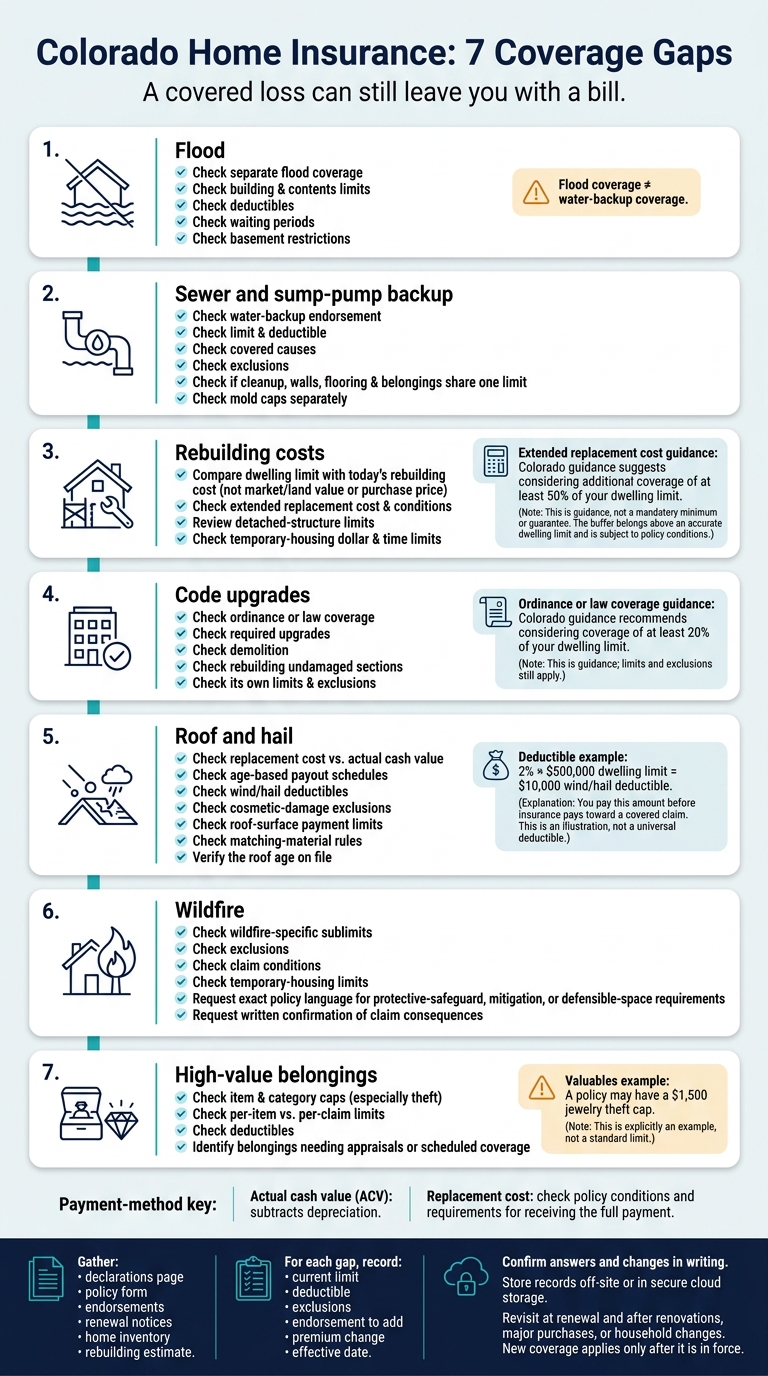
Colorado Home Insurance: 7 Coverage Gaps
Undercovered: Colorado's Home Insurance Dilemma
sbb-itb-bbf09a4
Gather Your Policy Documents
Before you check the seven gaps, gather the documents that spell out what your policy covers: declarations page, policy form, endorsements, renewal notices, home inventory, and rebuilding estimate. Ask for anything that’s missing, and make sure you’re using the latest versions.
Your declarations page lists coverage limits and deductibles. The policy form explains coverage, exclusions, and conditions, while endorsements change those terms. Compare renewal notices with your current policy to spot changes in limits, deductibles, or coverage.
Keep each coverage type separate. Dwelling covers your home. Other structures covers detached garages and similar buildings. Personal property covers your belongings. Additional living expenses, often called loss of use, covers eligible extra living costs after a covered loss.
Compare your dwelling limit with your rebuilding estimate and your personal property limit with your inventory. Write down each limit in dollars - not just percentages.
Ask your insurer for written confirmation that your other structures limit is enough to rebuild a detached garage at today’s construction costs. Also confirm the dollar limit and time limit for temporary housing after a wildfire. Get your deductibles, exclusions, and endorsements in writing, too.
Store copies of your policy, inventory, and rebuilding estimate off-site or in secure cloud storage. With those documents ready, start by checking flood exclusions.
1. Flood Exclusions
Standard homeowners policies generally don’t cover river flooding, flash floods, or surface-water runoff. Floodwater can also damage below-grade areas, such as basements.
A flood map is only part of the picture. Check your home’s location, how water drains around it, and whether runoff can reach basement windows or below-grade entrances. Confirm whether your Colorado community participates in the National Flood Insurance Program (NFIP). If it does, flood coverage may be available even outside high-risk zones.
Ask your insurer how the flood policy defines “flood.” Then check separate coverage limits for the building and its contents, along with deductibles, exclusions, waiting periods, and basement restrictions.
Flood coverage isn’t the same as water-backup coverage. Sewer backups and sump-pump failures typically need a separate endorsement. Next, check your sewer and sump-pump backup coverage.
2. Sewer and Sump-Pump Backup
Check your water-backup endorsement - not just your dwelling limit. Water-backup limits are usually much lower. Review the endorsement’s deductible, covered causes, and exclusions to see how it handles sewer or drain backups and sump-pump overflows.
If you have a finished basement, confirm coverage for cleanup, damaged walls and flooring, and stored belongings. Ask whether those expenses share a single limit. Also check whether mold-related expenses are covered, excluded, or capped separately.
Check how the policy pays for damaged belongings: actual cash value (ACV) or replacement cost. ACV subtracts depreciation, so the payment method can affect how much you receive.
Next, compare your dwelling limit with current rebuilding costs.
3. Limits on Rebuilding Costs
Base your dwelling limit on rebuilding cost - not market value, land value, or purchase price. If the limit is too low, hail or wildfire damage could leave you with a large gap between your coverage and the cost to rebuild.
Ask for a current replacement-cost review that accounts for square footage, construction quality, finishes, and local labor and material prices. Your dwelling limit sets the starting point for the rest of your rebuild coverage.
For a covered total loss, the dwelling limit is your base coverage cap. Check whether the policy pays actual cash value (ACV) first and what you must do to receive the remaining replacement-cost payment.
Extended replacement cost provides a buffer above that limit if rebuilding costs go up. Colorado guidance suggests considering additional coverage of at least 50% of your dwelling limit. Check the percentage cap and policy conditions. This buffer should sit above an accurate dwelling limit, not make up for one that's too low.
Check the separate dollar limits for detached structures. Review additional living expenses on their own, including the dollar limit, coverage period, and terms for extending coverage.
Next, check whether ordinance or law coverage pays for required code upgrades when rebuilding.
4. Code-Upgrade Coverage
An older home may need code upgrades after hail, wildfire, or another covered loss. Those upgrades can involve electrical systems, structural work, accessibility, or fire-resistant materials. Officials may also require demolition of undamaged parts of the home.
A covered loss doesn’t mean every repair cost is covered. Standard dwelling coverage may not pay the added costs of meeting current building codes.
| Coverage type | What it pays for | Main limitation |
|---|---|---|
| Standard dwelling coverage | Repairing or rebuilding covered damage | Does not automatically pay added costs imposed by building codes |
| Ordinance or law coverage | Required code upgrades, demolition, and rebuilding of undamaged sections | Subject to its own limits and exclusions |
This gap matters most when repairs after a covered loss must meet current building rules. Check whether your ordinance or law coverage pays for code upgrades, required demolition, and rebuilding undamaged sections.
Colorado guidance recommends considering ordinance or law coverage of at least 20% of your dwelling limit. Review your policy’s percentage or dollar limit.
Next, check how your policy pays roof and hail claims.
5. Roof and Hail Claim Payments
A covered hail loss doesn’t always mean your insurer will pay for a full roof replacement. Check whether roof damage is paid at replacement cost or actual cash value (ACV). Also look for an age-based payout schedule that reduces payment based on your roof’s age or material.
Review the declarations page for a separate wind/hail deductible. Is it a flat dollar amount or a percentage?
For example, a 2% deductible on a $500,000 dwelling limit equals $10,000.
Check for cosmetic-damage exclusions, limits on roof-surface damage payments, and matching-material rules. These terms can leave you paying part of a covered roof repair or replacement.
Verify the roof age on file and ask whether that age affects your payout.
Next, check wildfire limits and exclusions, which can also leave repair costs unpaid.
6. Wildfire Coverage Limits and Exclusions
Wildfire claims depend on policy conditions - not just coverage limits. Check for wildfire-specific sublimits, exclusions, and claim conditions. These terms can reduce your payment or lead to a denied claim, leaving you with out-of-pocket costs after a wildfire.
Ask your insurer for the exact policy language, page, and endorsement for any wildfire exclusion or protective-safeguard, mitigation, or defensible-space condition. Get written confirmation of each requirement and how missing it would affect your claim.
7. Limits on High-Value Belongings
After reviewing wildfire and roof claims, check coverage limits for high-value belongings. Your personal property limit doesn’t cover every item at full value. Category limits can leave you paying out of pocket after a covered claim. Ask your insurer to show how much it would pay after applying the sublimit and deductible.
Review jewelry, watches, fine art, firearms, electronics, and collectibles separately. Ask whether category limits differ for theft and other covered losses, and whether they apply per item or per claim. Also check whether off-premises theft or business-use restrictions affect coverage. High-value electronics may need a separate endorsement.
| Feature | Unscheduled personal property | Scheduled personal property |
|---|---|---|
| Limits | Standard policy sublimits | Item-specific insured limits |
| Valuation | Usually actual cash value unless endorsed | Replacement cost or agreed value, depending on terms |
| Deductible | Standard policy deductible generally applies | Often $0 or a lower deductible; verify |
| Documentation | Receipts and photos help support claims | Formal appraisals and detailed descriptions may be required |
| Restrictions | Theft caps; items that disappear without proof of theft may not be covered | Broader coverage, often including accidental loss or items that disappear without proof of theft |
For example, a policy may have a $1,500 jewelry theft cap.
Ask which appraisals, receipts, photos, serial numbers, and updated valuations your insurer requires. Update your inventory, then keep copies in cloud storage or an off-site safe-deposit box. That way, the event that damages your property won’t also destroy your records. Note which items need appraisals or scheduling before you write your action plan.
Write Your Coverage Review Action Plan
Turn the gaps you’ve found into one written action plan. Use a single review sheet to track all seven: flood exclusions, sewer or sump-pump backup, rebuilding limits, code-upgrade coverage, roof and hail terms, wildfire limits or exclusions, and valuables limits.
For each gap, record your current limit, deductible, exclusions, endorsement to add, premium change, and effective date. Flag unanswered questions so they don’t get lost.
Keep the plan with your policy documents in cloud storage or an off-site safe-deposit box. Review it with your insurer and confirm any changes in writing.
Revisit the sheet at renewal and after renovations, major purchases, or household changes. New coverage applies only after it is in force. Track what still needs action before your next renewal.
FAQs
How do I prioritize fixing my coverage gaps?
Start with a free, no-pressure policy review from Kamber Insurance Agency. It can help you spot coverage gaps, overlapping coverage, and chances to save. Focus on replacement cost rather than actual cash value, check your wind and hail deductibles, and consider umbrella coverage if you have major assets to protect.
Review your policy each year to account for changes in construction costs, inflation, and your personal assets. Call 303-551-6950 to get started.
Does water-backup coverage apply during a flood?
No. Water-backup coverage does not cover flood damage. Standard homeowners insurance policies generally exclude flood damage, too.
Water-backup endorsements cover losses caused by the failure or overflow of sump pumps, drains, or sewer lines - not flooding from outside your home.
Will my policy cover wildfire evacuation costs?
Your policy may help pay these expenses through loss of use coverage. If a severe wildfire leaves your home unlivable, this coverage can help cover temporary housing, hotel bills, and extra food costs while your home is being repaired.
Review your policy with your agent to check your coverage limits and confirm which expenses are covered while you’re displaced.