
Medicare Open Enrollment: A Plan Review Checklist
Compare 2027 Medicare plans step-by-step—estimate total costs, verify prescriptions and providers, and confirm coverage before Dec 7.

My Medicare review starts with one question: Will my coverage still fit my care and budget in 2027? Open Enrollment runs October 15–December 7, 2026. If I switch plans, my request must be received by December 7 for coverage that generally starts January 1, 2027.
Before I keep or change my plan, I’ll check:
Availability and costs: Review plan notices, confirm service in my area, and compare total yearly costs - not just premiums.
Prescriptions and care: Check each drug, pharmacy, doctor, hospital, and coverage when traveling outside Colorado.
My health needs: Review expected care, approval rules, and extra benefits I’ll use.
My final choice: Save my comparison notes and any enrollment confirmation, then arrange refills and January appointments.
My goal: fewer coverage surprises. I’ll use <u>2027 plan details</u> to make my decision.
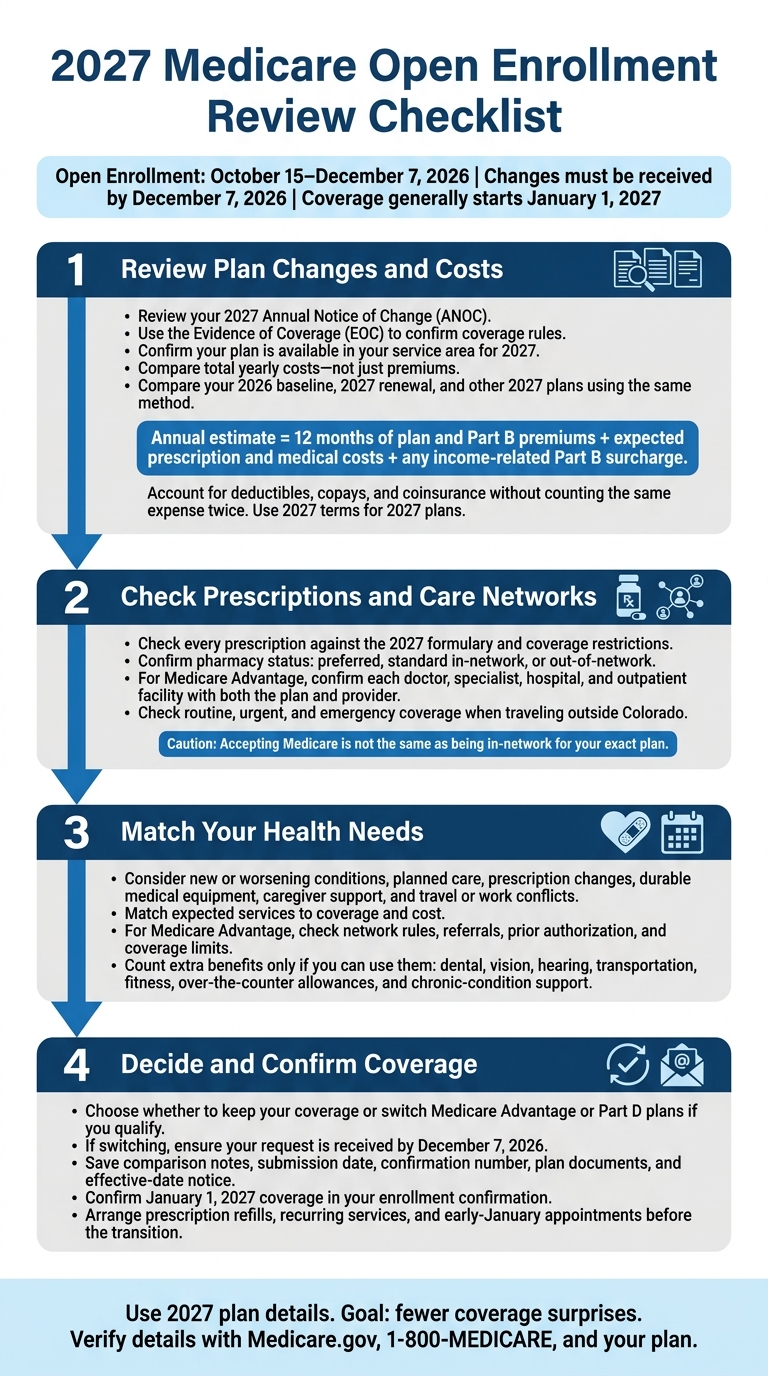
2027 Medicare Open Enrollment Review Checklist
Review Plan Changes and Costs
Read Plan Notices and Confirm Availability
Start with the official plan documents. Then check that your plan will still serve your area in 2027.
[ ] Review your 2027 Annual Notice of Change (ANOC). Check for changes to premiums, deductibles, copays, coinsurance, and coverage rules. Use the Evidence of Coverage (EOC) to confirm rule changes that affect your care, and flag anything that could change the care you receive now. [1]
[ ] Confirm availability in your service area. Plan availability, benefits, and premiums can vary by location. Make sure your Medicare Advantage or Part D plan is still offered for 2027. Visit Medicare.gov or call 1-800-MEDICARE to confirm availability and network changes. [1]
Decide whether to keep your plan, ask follow-up questions, or switch by December 7.
Compare Your Estimated Annual Costs
Estimate your total yearly cost based on the care you expect to use. Add 12 months of your plan premium and Part B premium, expected prescription and medical costs - including deductibles, copays, and coinsurance - and any income-related Part B surcharge. [1]
Use only 2027 plan terms when comparing your renewal with other plans. Apply the same calculation to each plan so your keep-or-switch decision reflects total yearly costs. Keep your 2026 costs as a baseline.
Current plan | Reviewed plan | Monthly premium | Deductibles | Prescription costs | Cost sharing | Estimated annual total |
|---|---|---|---|---|---|---|
2026 baseline | - | Record current monthly premium + Part B premium | Record current details | Estimate | Estimate | Estimate total |
2027 renewal | - | Record renewal premium + Part B premium | Record renewal details | Estimate | Estimate | Estimate total |
- | 2027 plan under review | Record plan premium + Part B premium | Record plan details | Estimate | Estimate | Estimate total |
Look beyond premiums. Include medical cost sharing and prescription drug costs so your estimate reflects the care you actually use. [1]
If the totals are close, compare prescription coverage, doctors, and pharmacy access before you decide.
Medicare Open Enrollment 2026: Your Checklist for 2027
Check Prescription Coverage and Care Networks
Check whether the plan covers the prescriptions, doctors, and pharmacies you use.
Verify Each Prescription and Pharmacy
Check every prescription against the 2027 formulary. Record whether each drug is covered and any rules that affect coverage or access. Confirm the details in Medicare.gov Plan Compare and the plan documents.
Verify your preferred pharmacy in Colorado. Review the 2027 pharmacy directory, then confirm the pharmacy’s network status directly. Note whether it is preferred, standard in-network, or out-of-network.
Confirm Providers and Out-of-Area Coverage
Confirm your Medicare Advantage network with both the plan and each provider. Start with the 2027 provider directory. Ask whether each provider is in-network for your exact plan - accepting Medicare isn’t the same thing. Check doctors, specialists, hospitals, and outpatient facilities separately before enrolling.
For each plan you’re reviewing, use the table below to record your current providers’ names, network status, and confirmation dates. These details can help you decide whether to keep your plan or switch.
Care provider or facility | 2027 network status and confirmation date |
|---|---|
Primary care physician: ______ | Status: ______; date: ______ |
Specialist: ______ | Status: ______; date: ______ |
Hospital: ______ | Status: ______; date: ______ |
Outpatient/urgent care: ______ | Status: ______; date: ______ |
Pharmacy: ______ | Preferred / standard / out-of-network: ______; date: ______ |
Check care-away-from-home rules separately. If you’re a Colorado member who travels, lives in rural Colorado, or spends part of the year elsewhere, confirm out-of-area coverage for routine, urgent, and emergency care. Ask which providers are covered and what you would pay. Don’t assume routine visits have the same coverage as emergencies.
Match Your Health Needs
Once you’ve compared costs and networks, check how each plan fits the care you expect to use in 2027. Focus on the benefits you’ll actually need.
[ ] New or worsening conditions
[ ] Planned surgery, hospital stays, or outpatient care
[ ] Prescription changes
[ ] Durable medical equipment, such as a walker or oxygen
[ ] Caregiver support for appointments and recovery
[ ] Travel or work conflicts
Check Medical Services and Coverage Rules
Match each expected service to its coverage and cost. Inpatient hospital care generally falls under Part A. Outpatient care and durable medical equipment generally fall under Part B.
For Medicare Advantage, check your share of costs, network rules, referral requirements, and prior authorization before you schedule care.
Review inpatient, outpatient, durable medical equipment, and skilled nursing benefits in the 2027 plan documents. Record copays, deductibles, network restrictions, referral requirements, prior authorization, and coverage limits.
Review Extra Benefits You Will Use
Focus on extras you expect to use: dental, vision, hearing, transportation, fitness, over-the-counter (OTC) allowances, and chronic-condition support. Check eligibility, approval requirements, participating providers, and benefit limits. Count a benefit only if you can use it.
Use this worksheet to record confirmed benefits and their costs. Keep these notes for your final plan comparison.
Need | Covered benefit | Restriction or limit | Estimated cost |
|---|---|---|---|
Dental, vision, or hearing care | |||
Transportation to appointments | |||
Fitness access | |||
Over-the-counter supplies | |||
Chronic-condition support |
Make Your Decision and Confirm Coverage
Keep Your Plan or Submit Changes by December 7
Use your comparisons to choose your coverage. Before you decide, double-check costs, drug coverage, provider networks, and the care you expect to need. You can keep your coverage or switch Medicare Advantage or Part D plans if you qualify.
Submit changes early enough for them to be received by December 7, 2026, so they can take effect on January 1, 2027. [1] Keep your submission date, confirmation number, plan documents, and effective-date notice together in one folder.
Confirm January 1 Coverage and Plan Your Care
After submitting your choice, check your enrollment confirmation. It should list January 1, 2027, as your effective date.
Arrange prescription refills, recurring services, and early-January appointments before the transition. If any documents are missing or incorrect, contact your plan or Medicare.gov right away.
Complete Your Medicare Review Worksheet
If you live in Colorado, record your confirmed 2027 details below. Mark any items that don’t apply as “N/A.”
[ ] Current plan name and type: ______
[ ] ANOC reviewed: ______
[ ] Monthly premium: $____
[ ] Medical deductible: $____ Medical out-of-pocket limit: $____
[ ] Part D deductible: $____ Estimated annual prescription costs: $____
[ ] Each medication’s formulary status and restrictions: ______
[ ] Doctors and facilities confirmed in-network: ______
[ ] Chosen pharmacy and preferred status: ______
[ ] Benefits I will use and restrictions: ______
[ ] Enrollment decision and selected plan: ______
[ ] Submission date: ______ Confirmation number: ______
[ ] Effective date confirmed; documents saved: ______
FAQs
Will my Medicare plan renew automatically if I do nothing?
Yes. Your current Medicare Advantage or Part D plan will generally renew automatically for the coming year if you do nothing. But premiums, benefits, and provider networks can change each year.
Use the October 15–December 7 Open Enrollment period to review your coverage and check that your plan still fits your health needs and budget.
Can I change plans after December 7?
You generally can’t change Medicare Advantage or Part D plans after December 7, when the Annual Enrollment Period ends [1].
But if you’re enrolled in a Medicare Advantage plan, you have another window: the Medicare Advantage Open Enrollment Period, January 1–March 31. During this time, you can switch to another Medicare Advantage plan or return to Original Medicare with a Part D plan [1].
Will I need new prior authorizations if I switch plans?
Switching Medicare Advantage or Part D plans may mean you need new prior authorizations. Each plan sets its own rules for which services and prescription drugs need approval before the plan will cover them.
Check the new plan’s formulary (list of covered drugs) and coverage rules to see how its requirements may affect your current health needs.