Small Business Insurance: A Guide to Coverage Types
Match business risks to the right policies—liability, property/BOP, workers' comp, cyber, and commercial auto. Review limits and exclusions.
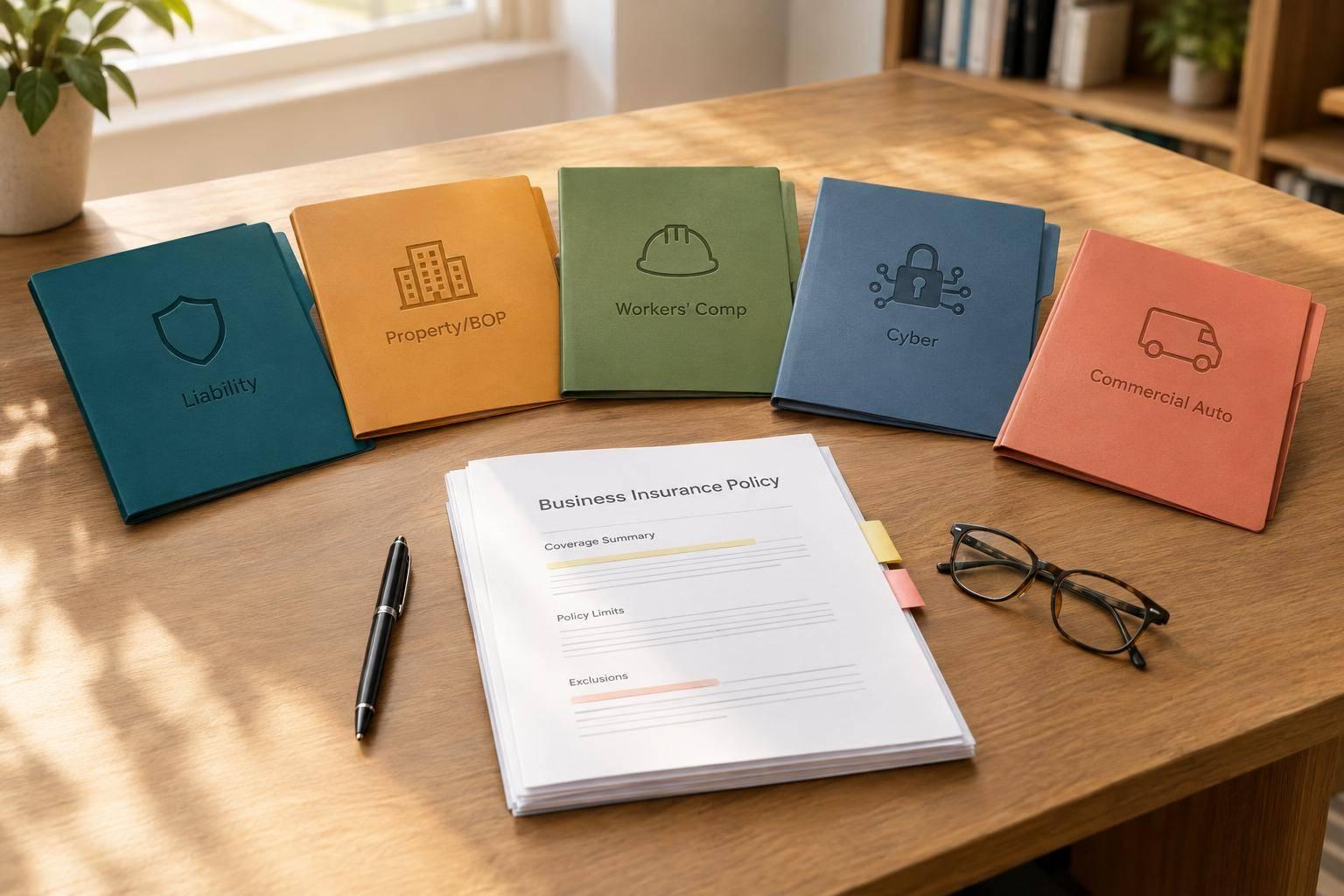
Small business insurance isn’t one policy that covers everything. I’d start by listing what could cost your business money: customer claims, damaged property, shutdowns, employee injuries, service mistakes, data breaches, and vehicle accidents.
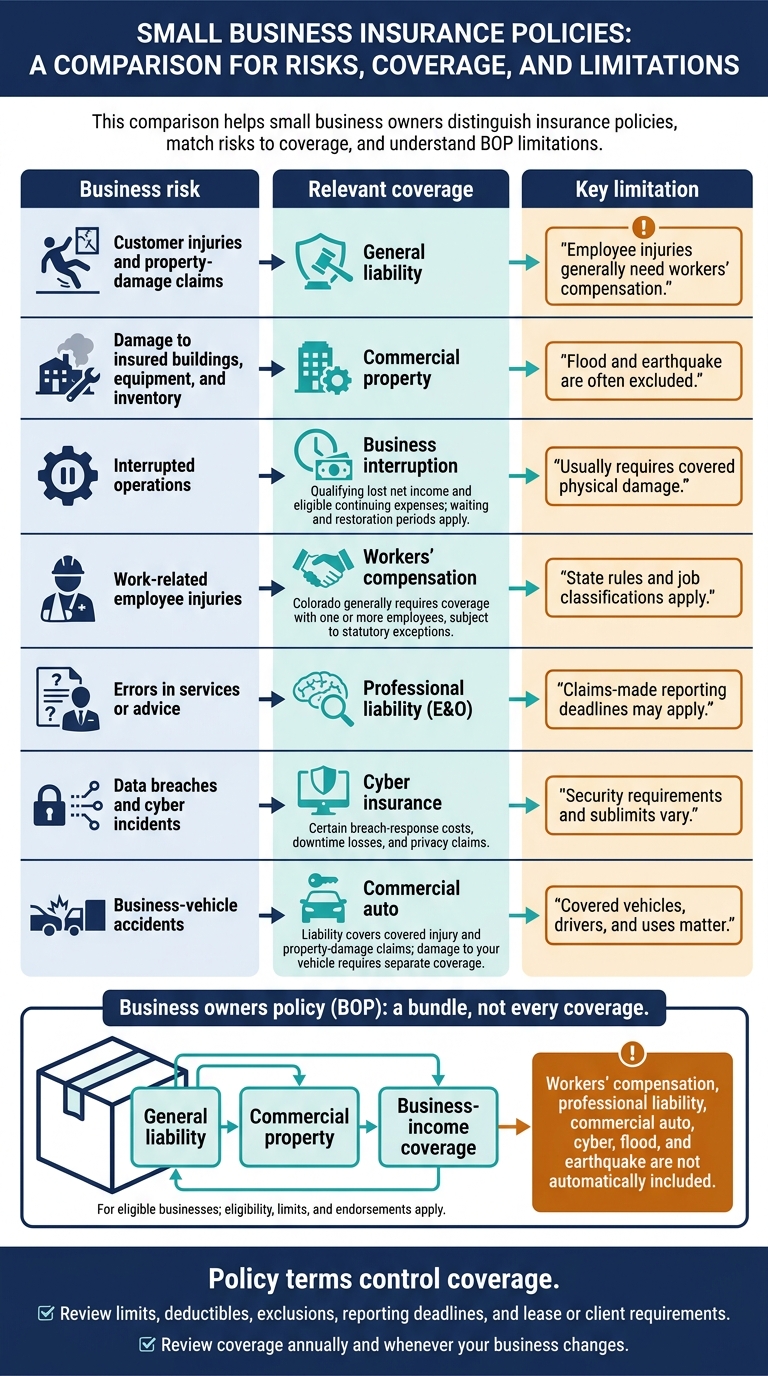
Here’s how I’d match those risks to coverage:
General liability: Customer injury and property-damage claims.
Commercial property: Damage to insured buildings, equipment, and inventory.
Business interruption: Qualifying lost income and continuing expenses after covered physical damage.
Workers’ compensation: Work-related employee injuries. Colorado generally requires it with one or more employees, subject to exceptions.
Professional liability: Claims involving errors in your services or advice.
Cyber insurance: Certain breach-response costs, downtime losses, and privacy claims.
Commercial auto: Covered business-vehicle accident claims; vehicle damage needs separate coverage.
Business owners policy (BOP): A package combining general liability, property, and business-income coverage for eligible businesses.
My starting rule: <u>check the policy terms, not just the policy name</u>. Before comparing quotes, I’d review limits, deductibles, exclusions, reporting deadlines, and lease or client requirements. Then I’d revisit coverage each year - and whenever the business changes. A bundle can simplify buying, but it doesn’t close every gap.
Small Business Insurance: Match Risks to Coverage
Insurance for Customer Claims, Property, and Lost Income
Customer claims, damaged property, and downtime are among the first losses many small businesses face. Start with policies that cover these risks.
General Liability Insurance
What it covers: Claims for third-party bodily injury, property damage, and personal and advertising injury, such as libel or slander. Medical payments coverage may also be included. Products and completed-operations coverage may apply if a product you sold or work you finished later causes injury or damage.
Key limitations: General liability usually doesn’t cover employee injuries, professional errors, or damage to your business’s own building, equipment, inventory, or supplies. Auto claims often need separate coverage.
Hypothetical business scenario: A customer slips on a wet floor in a Colorado retail shop and seeks payment for medical bills or other damages. General liability may cover the shop’s defense and a covered settlement or judgment.
Commercial Property Insurance
What it covers: Insured buildings, equipment, furniture, inventory, supplies, and tenant improvements damaged by a covered cause, such as fire, smoke, wind, hail, vandalism, or theft. It covers insured physical assets your business owns or leases - not lost income.
Key limitations: Replacement-cost coverage pays to repair or replace property with similar new property. Actual cash value subtracts depreciation. To receive the full replacement-cost payment, you may need to repair or replace the property.
Check your deductible and base coverage limits on current replacement estimates, including seasonal inventory. Underinsurance or coinsurance can reduce your payout. Flood, earthquake, wear and tear, deterioration, inadequate maintenance, and mechanical breakdown generally require separate coverage or are excluded.
Hypothetical business scenario: A covered shop fire damages shelving, point-of-sale equipment, merchandise, and interior improvements. Property coverage may pay for covered repairs or replacement after the deductible.
Property insurance pays for covered damage. Business interruption helps cover the income loss that follows.
Business Interruption Insurance
What it covers: Also called business income insurance, this coverage can replace lost net income and eligible continuing expenses when covered physical damage forces a shutdown. It pays for qualifying income loss and continuing costs - not property repairs.
Key limitations: Check the waiting period, income limit, payroll treatment, covered-income definition, exclusions, and restoration period. Depending on the policy, the waiting period may be 24 to 72 hours.[5] Coverage generally doesn’t last indefinitely until sales recover. Voluntary closures and losses from uncovered events usually don’t qualify.
Coverage | Covered loss | Triggering conditions |
|---|---|---|
Commercial property | Repair or replacement of insured assets | Physical damage from a covered cause |
Business interruption | Lost net income and eligible continuing expenses | Covered physical damage forces suspension; waiting and restoration periods apply |
Extra expense | Eligible relocation, rental, or other additional costs | Covered damage requires spending to continue operations or shorten recovery |
Hypothetical business scenario: The shop closes while fire repairs are completed. Property coverage addresses the damaged assets; business interruption may address qualifying income loss and ongoing expenses. Extra-expense coverage may help fund temporary retail space or leased equipment.
The next coverages address employee injuries, professional mistakes, and cyber incidents.
Insurance for Employee Injuries, Professional Errors, and Cyber Incidents
These policies address three types of risk: employee injuries, mistakes in your services, and cyber losses.
Workers’ Compensation Insurance
What it covers: Work-related medical treatment, partial wage replacement, rehabilitation benefits, and death benefits for qualifying workplace fatalities. Employers’ liability may also cover certain lawsuits tied to an employee injury, depending on policy terms and state law.
Key limitations: Colorado generally requires employers with one or more employees - including part-time staff - to maintain workers’ compensation without interruption, subject to statutory exceptions.[9][11] Verify payroll, job classifications, work sites, subcontractors, and temporary or seasonal workers. Calling someone a contractor does not, by itself, establish an exemption.
Hypothetical business scenario: An employee hurts their back lifting inventory. Promptly arrange appropriate medical evaluation, report the injury to the carrier, and document what happened. Workers’ compensation - not general liability - is the starting point for covered medical care and partial wage replacement.
Professional Liability Insurance
What it covers: Also called errors and omissions (E&O) insurance, this policy covers claims involving negligent services, incorrect advice, errors, or missed deadlines.
Key limitations: Policies may exclude known claims or circumstances, intentional wrongdoing, services outside the covered scope, and some contractual obligations. Many policies are claims-made, meaning the claim must first be made and reported within the required time frames. Check the retroactive date, keep coverage in place without gaps, and ask about prior-acts or extended reporting coverage when switching or ending a policy.[7][8]
Coverage | Claim type | Hypothetical business scenario | Main gap |
|---|---|---|---|
General liability | Third-party bodily injury or property damage | A contractor accidentally damages a client’s property | Usually does not cover purely financial loss from professional errors |
Professional liability | Financial loss from negligent services | An accountant’s filing error causes client penalties and additional professional fees | Coverage depends on insured services, exclusions, and reporting terms |
Cyber Insurance
What it covers: First-party coverage may pay for incident response, forensic investigation, notification, and data restoration. When included, cyber business interruption coverage may pay for qualifying downtime losses. Third-party coverage may address privacy or data-security claims.
Key limitations: Review security requirements, deductibles, sublimits, waiting periods, exclusions, and coverage for vendor incidents. Check social engineering, funds-transfer fraud, and extortion coverage separately, including any requirement to obtain consent.
Insurance does not replace cybersecurity controls. Use multifactor authentication, backups, patching, access controls, training, and an incident-response plan.[7][8][10]
Insurance for Business Vehicles and Bundled Coverage
Businesses that use vehicles need separate auto coverage.
Commercial Auto Insurance
What it covers: Commercial auto liability covers injuries or property damage caused by your insured vehicle, subject to policy terms. Coverage for damage to the vehicle is separate: collision covers crash damage, while comprehensive may cover theft, flooding, and other noncollision losses.[3][12]
Hypothetical business scenario: An employee rear-ends another vehicle while making a customer delivery in a company van. Commercial auto liability could cover the other driver’s injury and property-damage claims, plus the business’s legal defense. Repairing the van generally requires collision coverage, subject to a deductible. Damaged merchandise may require separate coverage.
Key limitations: Personal auto insurance may restrict business use and usually won’t cover a company-owned vehicle. Check that the policy lists the correct business name, covered vehicles, eligible drivers, delivery use, and operating territory. Review limits and deductibles, too.
For rented vehicles and employees’ personal cars used for work, review hired and non-owned auto liability. This coverage does not automatically pay for damage to those vehicles. Update your coverage when drivers, vehicles, or service areas change.[3][4][12]
Business Owners Policy (BOP)
A BOP combines core coverages in one package for eligible small businesses.
What it covers: A BOP bundles general liability, property, and business-income coverage.
Key limitations: Eligibility depends on business activities, size, premises, and other underwriting factors. Review building and inventory values, replacement-cost terms, deductibles, and property limits. Also check waiting periods and the restoration period - the policy-defined period used to determine covered business-income losses.[1][2][6]
Hypothetical business scenario: A retail shop in Colorado faces a customer slip-and-fall claim and later suffers a fire. Its BOP’s liability section could address the injury claim, while property coverage could pay for covered damage to inventory and fixtures. Business-income coverage may help with lost income and continuing expenses during a covered fire-related closure, subject to policy terms.[6][12]
Comparison factor | BOP | Separately arranged policies |
|---|---|---|
Bundled coverage | Combines core coverages in one package. | Each coverage is purchased individually. |
Flexibility | Convenient, but subject to eligibility, limits, and endorsements. | Allows more tailored limits, deductibles, and protections. |
Remaining gaps | Workers’ compensation, professional liability, commercial auto, cyber, flood, and earthquake are not automatically included. | Gaps depend on the policies purchased and how their terms fit together. |
Conclusion: Match Insurance to Your Business Risks
Choose policies based on your business risks - not a standard bundle. General liability doesn’t replace workers’ compensation, professional liability, commercial auto, or cyber coverage.
Before requesting quotes, gather your business’s legal name, locations, revenue, payroll, employee count, property values, services, vehicles, data exposure, and recent claims history. Use this table to build your quote checklist. Policy terms control coverage.
Business exposure | Relevant policy | Main limit |
|---|---|---|
Customer injuries | General liability | Employee injuries generally need workers’ compensation |
Damaged property | Commercial property | Flood and earthquake are often excluded |
Interrupted operations | Business interruption | Usually requires covered physical damage |
Employee injuries | Workers’ compensation | State rules and job classifications apply |
Professional errors | Professional liability | Claims-made reporting deadlines may apply |
Data breach | Cyber insurance | Security requirements and sublimits vary |
Vehicle accidents | Commercial auto | Covered vehicles, drivers, and uses matter |
Review coverage each year and whenever you hire, move, add services, buy equipment, or make other business changes. Check that your policies match your current risks and address known gaps, subject to their limits and exclusions.
FAQs
How much small business insurance do I need?
The amount of insurance you need depends on how your business runs, where it’s located, and the risks you face each day. Factor in the value of your equipment and property, your contracts, payroll size, and contact with customers or the public.
Review your coverage limits, deductibles, and endorsements regularly. Your coverage should keep pace as your revenue, locations, and services change.
Do I need insurance for a home-based business?
Yes. Standard homeowners insurance may not provide enough coverage for business activities, property, or liability. Review your risks based on how and where you work, whether you visit clients, and how much your equipment is worth.
A Business Owners Policy (BOP) is often a good place to start. It combines general liability and commercial property coverage in one package.
How can I lower premiums without leaving coverage gaps?
Match your coverage to how your business runs - not just the price. Review your property values, equipment, inventory, and liability risks to make sure your coverage limits fit your needs today. Update your policy when you hire employees, add services, or buy equipment.
An independent agent can help you choose deductibles and endorsements that fit both your budget and your coverage needs.